


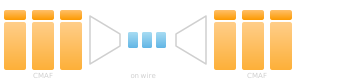
A CMAF track is a header plus fragments. The CMAF Header
(ftyp + moov, typically ~700–900 bytes) is needed
once: it rides in the catalog, shared with the plain cmaf track, and LOCMAF
leaves it untouched. What LOCMAF compresses is the per-fragment cost.
A CMAF chunk header for one sample is around ~100 bytes.
With sample-level objects (every video frame, every audio frame is one MoQ object), that overhead becomes a meaningful share of the wire cost — roughly a quarter of the wire for 128 kbps AAC, ~37 % at 64 kbps, and more than half for 32 kbps Opus — where the moof is larger than the media it describes — smaller for video where the media bitrate still dominates.
LOCMAF observes that consecutive moof boxes are almost identical and delta-encodes them — applied to clear audio
and cbcs audio the delta moof shrinks to two bytes, and the same approach extends to DRM-protected video.
It targets the same low-latency CMAF-chunk workload as LL-HLS Parts and DASH Chunked CMAF —
with the per-chunk moof overhead compressed away on the MoQ wire.
Seven boxes, each paying an 8-byte size + fourcc header — that is 56 bytes.
Four version/flags words add 16 more. So
72 of the 100 bytes carry no media information at all, and each of the six numbers
that remain is already known to the receiver: the sequence number is unused, the track ID comes from
the init, the sample size equals the MoQ object length, the decode time is the previous one plus the
previous duration, the sample count is unchanged, and the data offset is implicit.
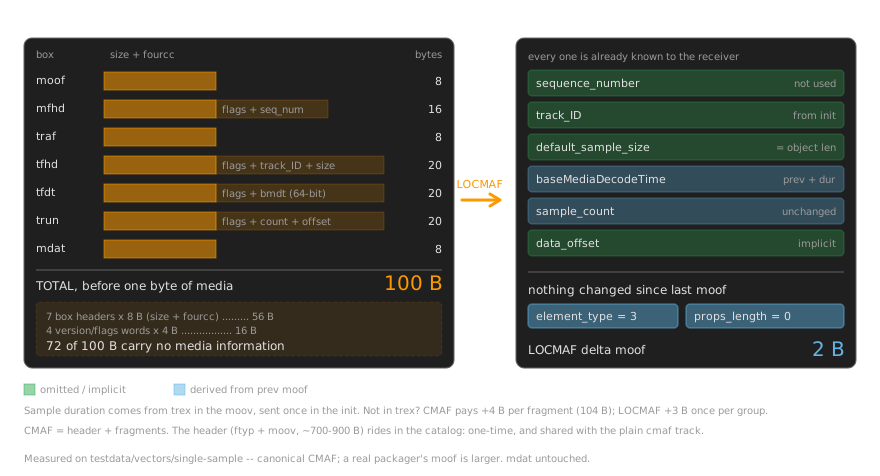
testdata/vectors/single-sample.
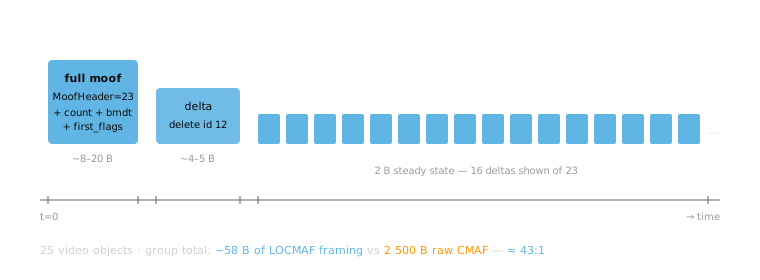
A LOCMAF group therefore needs only two things: the first baseMediaDecodeTime
and the sample duration — and the duration is normally already in trex in the
moov, delivered once with the init. CMAF also allows it in the tfhd; signaling it
there instead costs +4 bytes in the group's first object. Everything after that object is
a 2-byte delta.
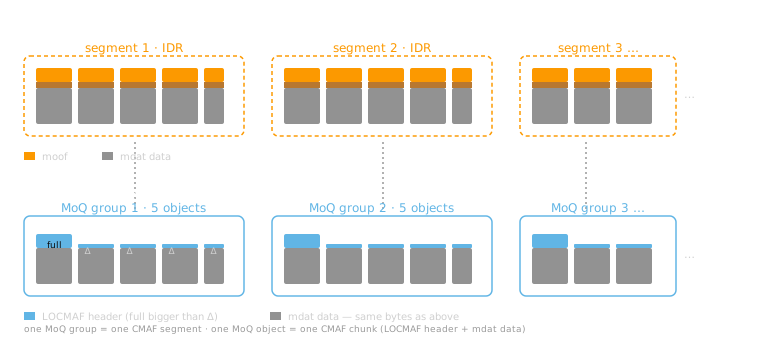
The natural mapping. Each MoQ group starts at a random-access point (IDR for video). Inside a group, objects are delivered in order, and that ordering is what makes the delta stream possible. Audio groups are aligned to video groups so a tune-in operation can deliver both clocks at once.
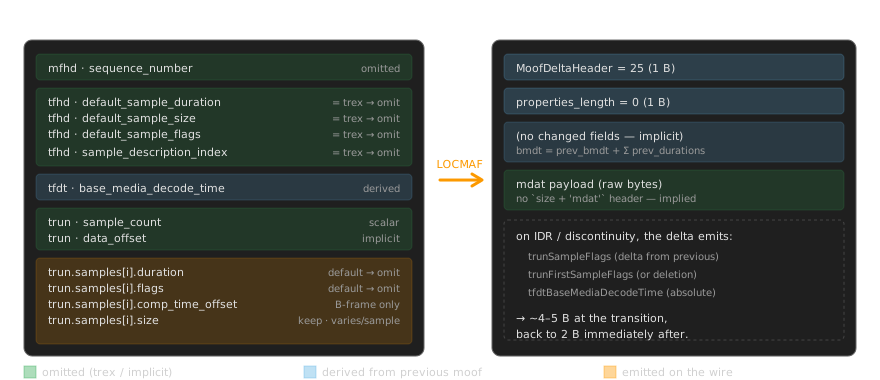
Consecutive moof boxes differ only in a handful of fields. LOCMAF compresses in two stages:
trex are omitted entirely.
base_media_decode_time is derived implicitly from the previous moof's sample durations;
a timeline discontinuity (splice, capture gap) re-anchors with a new full header.
The mdat box header never goes on the wire — its length is implied by the MoQ object length.
Measured against assets/test10s/video_400kbps_avc.mp4 — a 250-fragment AVC group with one sample per fragment.
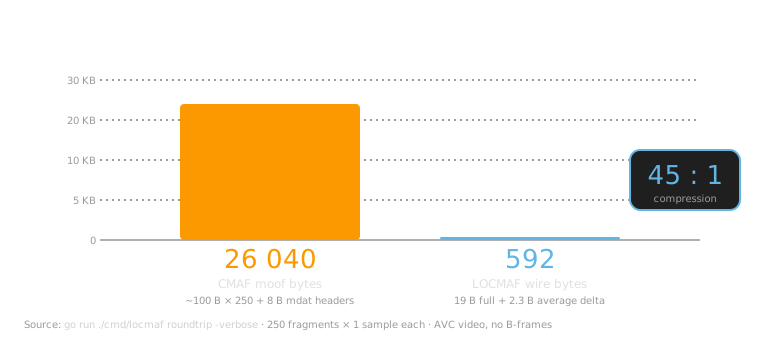
The CMSF catalog reports the wire bitrate including framing. The moof saving per object is essentially constant (~100 B → 2 B ≈ 99.6 B/object), so the percentage saving grows as the track's bitrate shrinks — audio gains the most.
| track | sample | CMAF | LOCMAF | saved |
|---|---|---|---|---|
audio_128kbps_aac | 128.0 kbps | 171.5 kbps | 131.9 kbps | 23.1 % |
video_400kbps_avc | 373.2 kbps | 396.4 kbps | 376.5 kbps | 5.0 % |
The 128 kbps AAC track lands within ~3% of the raw sample bitrate — the remaining LOCMAF overhead is ~2 B/object × ~47 obj/s ≈ 0.75 kbps plus the MoQ object framing.
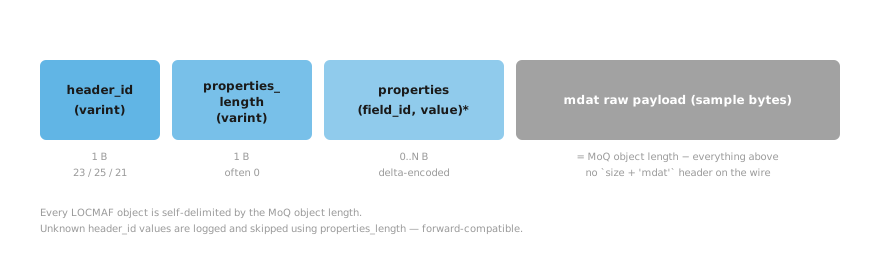
Every MoQ object is zero or more genBox elements, exactly one
moof header (full or delta), and the raw mdat payload.
Each element starts with an element_type vi64:
| element_type | Symbol | Meaning |
|---|---|---|
| 1 | genBox | one generic pre-moof box (styp / prft / emsg / uuid), carried verbatim |
| 2 | locmafFullHeader | full moof header (absolute encoding) |
| 3 | locmafDeltaHeader | delta moof header (in-group deltas) |
The CMAF Header (init) is delivered verbatim via the MSF / CMSF
catalog — the same init-data entry a plain cmaf track uses,
so the two packagings of one source can share it. Init is a
one-time-per-track cost; LOCMAF compresses the per-chunk overhead.
No codepoints leave the LOCMAF payload, so nothing needs an IANA registry:
the catalog's packaging: "locmaf" declaration scopes the bytes
before any object arrives. Extension happens through new genBox
box types and new field IDs (unknown field IDs are skipped via the parity
rule); the element types themselves are fixed per locmafVersion.
Two-byte LOCMAF framing carries one whole moof worth of information.
base_media_decode_time advances implicitly; per-sample fields are unchanged from the previous moof.
Single sample size is calculated from total object size.
The 2-byte steady state holds for clear content and for cbcs audio.
Sub-sample encryption on video adds the subsample map per fragment (~6 B steady state),
and cenc additionally carries the per-sample IV — see the
DRM section below for the measured impact.
LOCMAF's primary use case is low-latency DRM-protected streaming over MoQ.
The encrypted mdat bytes, per-sample IVs, subsample byte ranges,
and the tenc defaults (including default_KID) are carried verbatim —
so the standard CDM / MSE / EME path on the receiver works as if the content had arrived as plain CMAF.
LOCMAF is invisible to the player.
CMSF carries the DRM description at the catalog level; LOCMAF doesn't replace it.
A contentProtections array is referenced by per-track
contentProtectionRefIDs, mirroring DASH-IF IOP 6.
{
  "contentProtections": [{
    "refID": "widevine",
    "defaultKID": ["abcdef0123456789abcdef0123456789"],
    "scheme": "cbcs",
    "drmSystem": {
      "systemID": "edef8ba9-79d6-4ace-a3c8-27dcd51d21ed",
      "laURL": { "url": "https://lic.example.com/widevine", "type": "POST" },
      "pssh": "base64-pssh-box"
    }
  }],
  "initDataList": [{ "id": "v1init", "type": "base64", "data": "..." }],
  "tracks": [{
    "name": "video_400kbps_avc_drm",
    "packaging": "locmaf",
    "locmafVersion": "0.3",
    "contentProtectionRefIDs": ["widevine", "playready", "fairplay"],
    "initRef": "v1init"
  }]
}
The receiver picks the first refID whose drmSystem.systemID matches a CDM it can talk to,
then uses the named pssh / laURL to set up the MediaKeySession exactly as for a plain CMSF stream.
cenc vs cbcs on the wire| scheme | per-sample IV | subsample map | extra delta-moof cost |
|---|---|---|---|
cenc | per-sample, 8 or 16 B | ~3 B/subsample (video) | ~16 B IV + subsample bytes |
cbcs | constant IV in tenc | ~3 B/subsample (video) | subsample bytes only |
Audio uses full-sample encryption under both schemes, so audio under cbcs costs the same on the LOCMAF wire as clear audio —
the constant IV lives once in the moov and no per-fragment encryption signaling is needed.
Video carries the subsample map under both schemes.
| track | scheme | CMAF | LOCMAF | saved |
|---|---|---|---|---|
audio_128kbps_aac | cbcs | 191.4 kbps | 131.9 kbps | 31.1 % |
audio_128kbps_aac | cenc | 197.4 kbps | 138.6 kbps | 29.8 % |
video_400kbps_avc | cbcs | 408.8 kbps | 378.5 kbps | 7.4 % |
video_400kbps_avc | cenc | 412.0 kbps | 382.1 kbps | 7.3 % |
LOCMAF saves more relative to CMAF on DRM-protected content than on clear content —
the CMAF moof grows under encryption (extra senc / saio / saiz) while LOCMAF only emits what it actually needs.
The receiver regenerates senc, saiz, and saio canonically,
and the scheme is carried agnostically — cbc1 and cens ride the same fields.
The 2-byte steady state requires every frame to have an integer duration in the chosen media timescale:
| stream | timescale | ticks per frame |
|---|---|---|
| 48 kHz AAC | 48 000 | 1 024 |
| 60000/1001 fps video (NTSC) | 60 000 | 1 001 |
With a mismatched timescale each frame drifts ±1 tick, and the per-sample duration array has to be sent every fragment — the 2-byte steady-state delta moof is no longer achievable.
CMAF (ISO/IEC 23000-19) tightens ISOBMFF: each CMAF Track carries exactly one media track,
each CMAF Chunk is one moof followed by exactly one mdat
(§7.3.3.2), and each traf contains exactly one trun (Table 4).
These restrictions are what make LOCMAF's "one MoQ object = one moof + one mdat" mapping unambiguous —
a short element sequence, and the rest of the object is mdat payload.
General fragmented MP4 may contain multiple traf / trun boxes per moof,
multiple mdat boxes per fragment, or multiple tracks multiplexed into one file.
LOCMAF does not address those layouts directly. Source content must be CMAF-conformant
(or trivially repackaged into CMAF) before LOCMAF encoding.
The first version of LOCMAF was developed as part of Hugo Björs's KTH MSc thesis, Efficient DRM in MoQ using Low Overhead CMAF (2026), under the supervision of Torbjörn Einarsson at Eyevinn Technology.
The format is intended as a packaging encoding in the CMSF catalog and complements the Low Overhead Container (LOC) defined by the MoQ working group.
The packaging is at locmafVersion "0.3", specified in
draft-einarsson-moq-locmaf
and advertised in the CMSF catalog Track entry whenever
packaging == "locmaf". Following the June 2026 MoQ interim,
LOCMAF is being folded into
CMSF
as a packaging mode rather than proceeding as a standalone draft.
The Go reference encoder and decoder live in Eyevinn/locmaf
and are used by the Eyevinn/moqlivemock server and subscriber;
the browser player is Eyevinn/warp-player. All three implement
v0.3 and interoperate end to end.